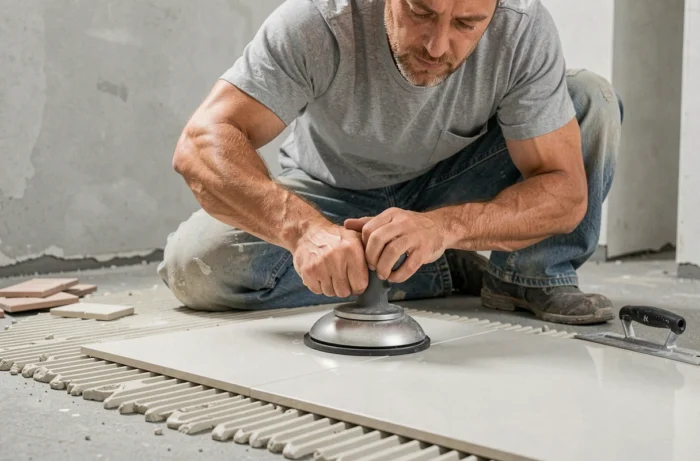
On a bathroom construction site, laying a large-format tile with two hands without a gripping tool risks breakage at the first adjustment on the adhesive bed. The tile installation suction cup addresses this specific problem: it provides a stable grip on the surface to move, orient, and place the tile without twisting stress. Understanding its variations and limitations of use changes the quality of the final result.
Load capacity and tile geometry: what the technical sheet doesn’t always say
We often look at the announced load capacity in kilograms, but this figure alone is not enough. A long and thin tile puts different stress on the suction cup compared to a square and thick tile: twisting increases with the length of the slab, even at the same weight.
When handling a narrow rectangular format, a centered single suction cup does not stabilize the ends. The slab bends under its own weight, and the risk of cracking appears even before installation. This is why multi-suction cup handling frames exist: they distribute the grip over the entire surface.
RUBI describes, for example, a frame equipped with six pump suction cups, adaptable to very large format pieces. This type of system can even integrate automatic vacuum reactivation to compensate for pressure loss during handling. Therefore, the tile installation suction cup is chosen based on the actual geometry of the piece, not just its weight.
Manual suction cup or pump suction cup: selection criteria based on tile surface
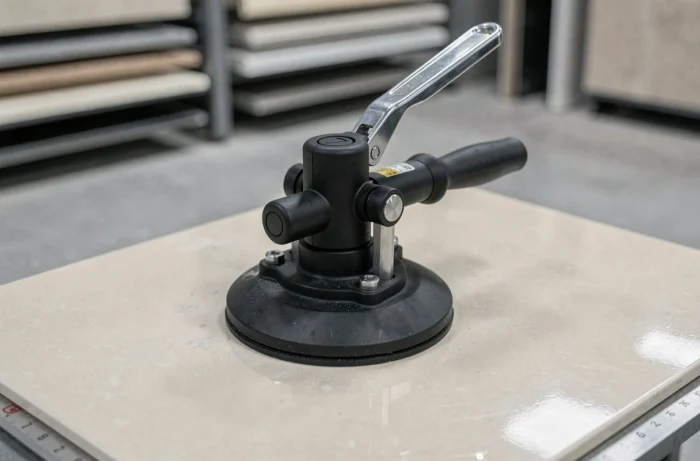
The manual suction cup works by simple pressure: it is applied to the tile, pressed to expel air, and adhesion is created. It is suitable for small and medium-sized tiles, on perfectly smooth surfaces (glazed stoneware, polished earthenware).
The pump suction cup adds a lever or handle that allows for more air to be extracted. It maintains a stronger and more consistent vacuum, making it suitable for heavy tiles or slightly textured surfaces. On a structured surface, a manual suction cup loses its seal in a few seconds, while a pump partially compensates for micro-reliefs.
When an electric suction cup is justified
For high installation rates or slabs exceeding one meter on a side, motorized models incorporate additional safety devices. Some professional systems include a vacuum indicator, an alarm in case of pressure drop, and a two-action release control. These safeguards protect both the tile and the hands of the installer.
The additional cost of an electric suction cup is justified on sites where dozens of large format slabs are handled daily. For a standard-sized bathroom or kitchen, it remains oversized.
Surface preparation and sealing of the grip: common mistakes on site
A suction cup only adheres properly if the surface of the tile is clean, dry, and sufficiently smooth to create an airtight seal. In practice, it is often forgotten that cutting dust or a film of dried adhesive on the surface is enough to break the suction.
Here are the points to check before each grip:
- Clean the tile surface with a damp cloth and wait for it to dry. A greasy residue (release oil, fingerprint) reduces the useful contact area.
- Check that the rubber lip of the suction cup is neither cracked nor deformed. A damaged lip no longer compensates for irregularities, even minimal ones.
- On a tile with pronounced relief (reconstituted slate, structured stoneware), test the adhesion in a vacuum before lifting. If the suction cup slips after a few seconds, the material is not compatible with this model.
The loss of adhesion during handling remains the main factor for breakage. A quick check a few seconds before lifting eliminates most incidents.
Tile installation suction cup and safety: what handling a fragile load implies
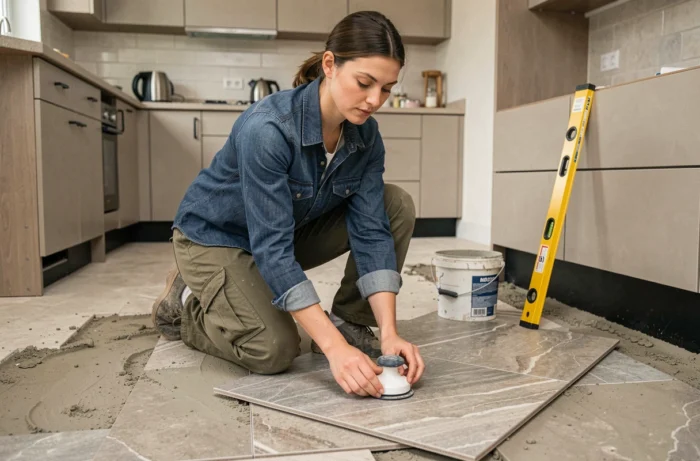
As soon as a tile is lifted with a suction cup, a lifting operation is performed. It is not just a matter of comfort: the Inforisque guide on mechanical handling reminds us that the choice of equipment must take into account the load, its gripping points, and the conditions of use.
The main risk is not the suction cup falling, but the load falling on feet or hands. A large format tile that detaches at waist height can cause serious injuries. Two concrete precautions reduce this risk:
- Always lift the tile as close to the ground as possible and move it at hip height, never above head height.
- Clear the installation area so that no one is under the tile’s trajectory. On a site with multiple workers, announce the movement before lifting.
- Regularly check the condition of the suction cups: a rubber lip ages, hardens, and loses its sealing capacity over the months.
A tool to inspect like any lifting accessory
We don’t always think to consider the suction cup as a lifting accessory subject to inspection. Regulations on the inspection of lifting devices provide for periodic verification points. Without going as far as a formal register for occasional use, inspecting the lip and pump mechanism before each site avoids unpleasant surprises.
The choice of a tile installation suction cup is based on three concrete parameters: the geometry of the tile, the condition of its surface, and the planned installation volume. A manual model with a soft lip covers the majority of residential sites. For large format or intensive installation, a pump system with a vacuum indicator provides a margin of safety that simple manual pressure does not guarantee.