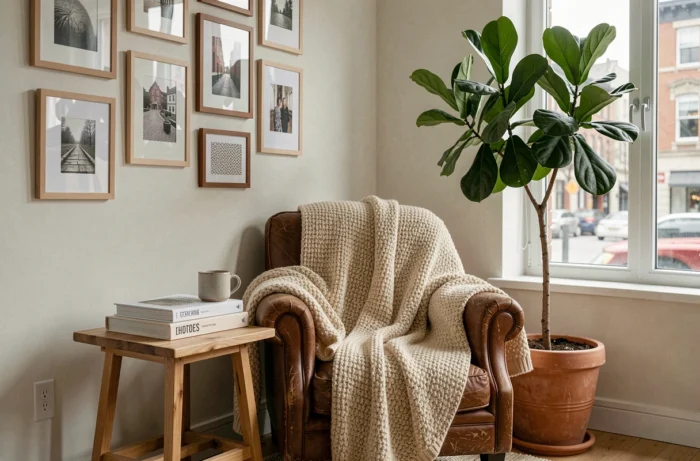
Decorating a home often means balancing visual appeal with everyday practicality. Choosing a decorating style, a color palette, or a type of furniture also raises less visible questions: indoor air quality, the home’s energy performance, and how well the space will adapt over time. Assessing these factors before choosing a sofa or wall color changes the order of priorities.
Air quality and decorating choices: what materials really emit
Paints, adhesives, flooring, and new furniture can release volatile organic compounds (VOCs). A national survey conducted in 571 homes between 2020 and 2023 confirms an overall improvement compared with 2003–2005, but some pollutants remain above reference levels in a proportion of homes.
In practical terms, choosing glued parquet, acrylic paint, or particleboard furniture does not have the same impact on the air you breathe. Three criteria can help you assess products effectively before buying:
- The regulatory emissions label (rated from A+ to C) appears on construction and decorating products sold in France. Products rated A+ emit the fewest VOCs.
- Additional labels (Blue Angel, EU Ecolabel, NF Environnement) set stricter emissions limits than the basic regulations.
- Home ventilation remains the main corrective factor: even with low-emission materials, a poorly ventilated interior allows pollutants to build up.
A decorating project that takes these factors into account from the outset can prevent costly fixes later, such as replacing high-emission flooring or installing a mechanical ventilation system at a later stage.
For more practical ideas on interior design, Paris vu d’avion’s home section features additional articles on the subject.

Interior decorating and energy performance: the timeline to follow
Updating a home’s appearance without considering its energy rating can mean doing the same work twice. Since January 1, 2025, homes rated G on the DPE energy performance certificate no longer meet energy efficiency standards for new rental agreements covered by the rules in mainland France.
For homeowners planning to redecorate, this timeline sets a clear order of priorities. Insulate a wall before painting it, replace windows before installing made-to-measure curtains, and plan a room’s layout around a new heating system: the sequence of work affects the decorative result as much as thermal comfort.
| Renovation work | Decorative impact | Energy impact |
|---|---|---|
| Internal wall insulation | Reduces living space and changes the room’s proportions | Reduces heat loss |
| Window replacement | Changes the visual frame, natural light, and curtain options | Improves the DPE rating |
| Flooring | Sets the overall mood of the room | Insulating flooring reduces heat loss through the floor |
| Wall paint | The main aesthetic tool, at a moderate cost | No direct impact on performance |
This table shows that work with a major energy impact (insulation, windows) also changes the space’s dimensions and light. Doing it first avoids repainting a wall that will need to be covered with insulation six months later.
Interior design and mobility: plan ahead instead of making changes later
An interior designed solely for its appearance can become impractical with age or reduced mobility. Rather than treating accessibility as a separate project, incorporating it from the decorating stage makes it easier to make lasting choices.
Keeping pathways clear, minimizing floor-level obstacles (rugs with curled edges, exposed cables, low furniture in walkways), and planning for bathroom access: these decisions are as much about design as they are about safety. The MaPrimeAdapt’ scheme, launched in 2024, provides funding for home adaptation work subject to certain conditions, which can cover part of the cost of a comprehensive redesign.
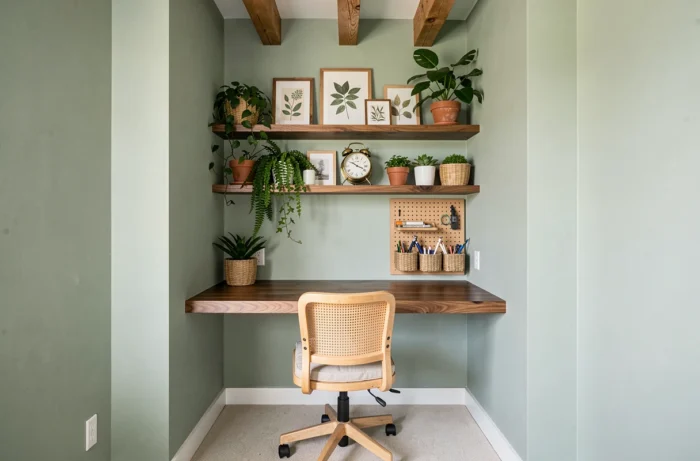
A hallway at least 90 cm wide, lever door handles instead of knobs, and a level-access shower instead of a bathtub: these choices do not dictate a particular style. They fit into contemporary, industrial, or classic interiors without any visible compromise.
Colors and space: choose a palette to suit each room’s purpose
Choosing colors for a home is about more than personal taste. Light shades make a small space look larger, while dark tones create a cocooning feel that works well in bedrooms or offices. Matching colors to the purpose of each room creates a more cohesive result than using the same palette everywhere.
A living room that also serves as an office calls for different lighting and colors than a child’s bedroom. Testing paint samples directly on the wall in question at different times of day remains the most reliable way to avoid disappointment.
Furniture and decorative accessories: choose based on how you really use them
Furniture is often the most visible expense in an interior decorating project. The temptation to buy on impulse often leads to underused pieces that take up space.
Listing how you actually use each room before choosing furniture helps avoid this trap. A dining table used three times a year does not justify sacrificing two square meters of everyday circulation space. A beautiful but uncomfortable accent chair will end up covered in clothes.
Personal decorative items (travel souvenirs, books, handmade creations) add more character than a matching set bought as a bundle. They tell a story that catalogs cannot, and gradually collecting them over time creates an interior that evolves with the people who live there.
The key to a successful interior lies less in the style you choose than in carefully balancing aesthetics, health, and durability. A home that reflects who you are is first and foremost a home that works for you, in the most practical ways.