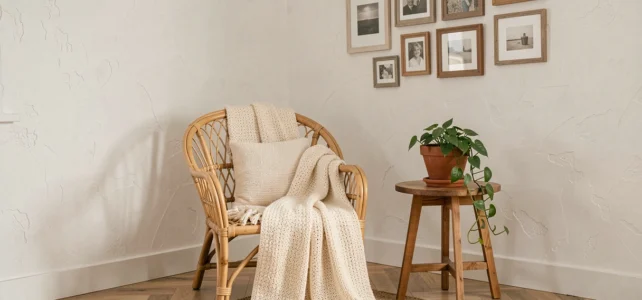
Decorating your interior on a tight budget means choosing where to focus every euro. Trendy budget decoration does not rely on accumulating clever purchases, but on the ability to identify the elements that truly transform a room. Which levers offer the best balance between expense and visual impact? Recent data on the furniture and decoration market in France allows us to prioritize these choices.
Second-hand and new furniture: where the decoration budget really goes
The French furniture and decoration market is contracting for the third consecutive year in 2025. An increasing portion of the demand is shifting towards second-hand items, reshaping the possible trade-offs for decorating at home.
According to the Ameublement et décoration study by Leboncoin Solutions Pro (June 2026), about a quarter of the furniture purchased in the year is second-hand. And 71% of the French say they are comfortable with buying second-hand furniture.
| Decoration item | New (entry-level) | Second-hand | Visual impact |
|---|---|---|---|
| Coffee table / side table | Moderate | Significantly cheaper | High (focal point of the living room) |
| Decorative lighting | Variable depending on style | Often available in good condition | High (changes the entire ambiance) |
| Textiles (cushions, curtains) | Low | Rarely relevant (wear) | Medium to high |
| Small storage (shelves, baskets) | Low | Very accessible | Medium (structuring) |
| Paint (an accent wall) | Low (can + roller) | Not applicable | Very high |
This table reveals a point that classic tip lists often overlook: second-hand is only relevant for certain items. A second-hand sofa or table allows for substantial savings. In contrast, textiles (cushions, throws, curtains) lose their appeal when second-hand, as wear quickly degrades their decorative effect. It’s better to buy them new, at entry-level prices.
Specialized platforms like decopascher.fr list decorative pieces at reduced prices, allowing for quick comparison of options without extensive searching.

Paint and lighting: the two items with the best decorative return
If only one item should concentrate the budget, it would be paint. An accent wall in a living room or bedroom changes the perception of the entire space for the price of a can and a roller. The current trend favors terracotta shades, deep greens, and warm beiges, which work well in both small apartments and spacious rooms.
Choosing the surface to paint
The most effective wall to treat is the one that hosts a focal element: headboard, TV unit, bookshelf. Painting just one wall is inexpensive and avoids the saturated effect produced by four colored walls in a small room.
Lighting is the second most cost-effective lever. Replacing a central ceiling light with two or three distributed light sources (table lamp, string lights, wall sconce) transforms the atmosphere of a living room without heavy intervention. Second-hand floor lamps in good condition offer particularly favorable value for money.
Common mistakes in decorative lighting
- Keeping a single ceiling light, which flattens the volumes and gives a cold rendering to the furniture
- Choosing cold color temperature bulbs (bluish white) in living areas, while warm light enhances textiles and wood
- Neglecting accent lamps in favor of less structuring decorative accessories for the ambiance
Textiles and plants: adjusting style without changing everything
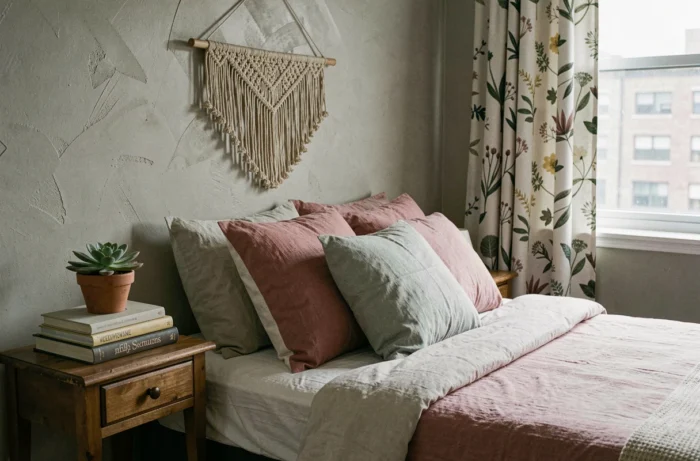
Textiles allow you to refresh an interior without touching the furniture. Changing cushion covers, adding a throw, or replacing tired curtains is enough to modify the color palette of a room.
Textiles are the quickest lever to follow a seasonal trend. A set of three linen or textured cotton cushion covers costs less than a decorative accessory and can be easily replaced from season to season.
Green plants play a comparable role. They add volume, color, and an organic dimension that furniture alone does not produce. The hardiest varieties (pothos, sansevieria, chlorophytum) require little maintenance and can be found at low prices in garden centers or through exchanges between individuals.
Visible storage: when organizing becomes decorating
Storage is rarely approached as an aesthetic choice, but in a small space, well-thought-out storage has as much effect as a decorative object. Natural fiber baskets, an open shelf filled with books and a few objects, or matching boxes on a console visually structure the room.
The goal is not to hide everything, but to choose what remains visible. Three objects arranged on a shelf with space around them create a more polished effect than an overloaded shelf. This principle of decoration by subtraction works in all rooms and costs nothing.
- Group objects by material or color rather than by function
- Leave at least one-third of the surface empty on each shelf
- Use containers (baskets, boxes, trays) to visually unify disparate objects
The decoration market is evolving towards a logic where second-hand items and micro-interventions (paint, lighting, textiles) are gradually replacing new furniture purchases. The most transformative items remain the cheapest, making trendy decoration on a budget more accessible than it has been in recent years.