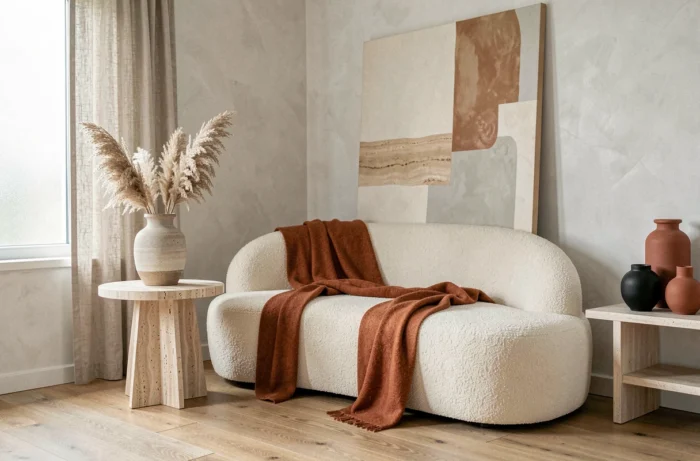
Each season brings its share of new trends in interior decoration, but not all are created equal. Among the decor trends emerging this year, some reflect a genuine change in our relationship with living spaces, while others are merely cosmetic recyclings. To clarify, this article compares the directions that are truly shaping interiors in 2026: materials, palettes, and composition styles.
Collected over time decor vs. coordinated interior: what the data shows
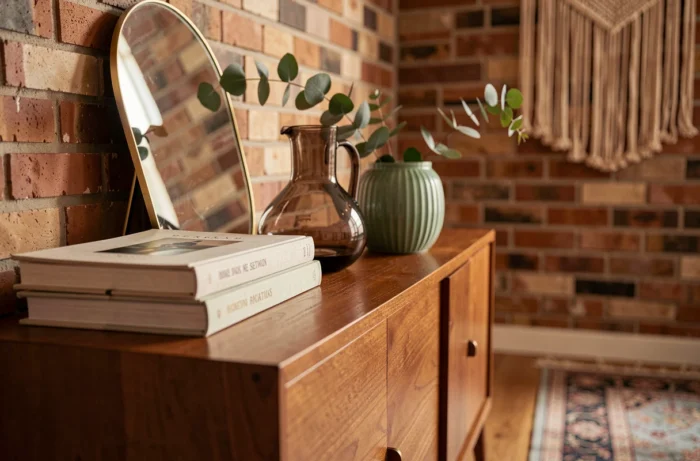
The 2026 trends report from Houzz identifies the collected over time style as a strong trend. The principle: to compose an interior from objects accumulated over the years (inheritances, vintage pieces, travel souvenirs) rather than buying a complete decor from the same store.
This approach is a direct reaction to the overly coordinated interiors popularized by social media. The increase in searches for rust and chocolate brown colors, associated with this more lived-in aesthetic, confirms the movement.
| Criteria | Coordinated interior (catalog style) | Collected over time |
|---|---|---|
| Source of objects | Bulk purchase, same store | Gradual accumulation, multiple origins |
| Dominant palette | Monochromatic, strict harmony | Rust, chocolate brown, embraced color variations |
| Furniture | Homogeneous range, identical materials | Mismatched furniture, mixed woods, varied patinas |
| Perceived durability | Frequent renewal with trends | Pieces kept for a long time, sentimental value |
| Entry cost | High initial investment | Gradual, budget-friendly |
Among the decor trends to discover this year, collected over time is probably the one that most changes the way we consume furniture and decorative objects.
Earthy palettes and deep colors: the shades that shape decor in 2026
Color palettes are evolving in two simultaneous directions. On one hand, earthy tones (clays, golden sands, terracottas) are becoming dominant in living spaces. They replace the sterile white that has dominated interiors in recent years.
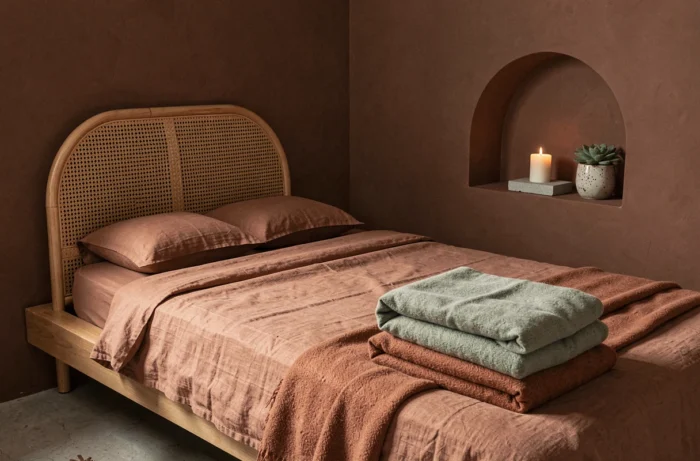
On the other hand, bolder colors are gaining ground. Emerald green, midnight blue, and chocolate brown are appearing in bedrooms and living rooms as markers of identity. However, pastels are not disappearing: they are migrating to secondary rooms (entryways, offices, bathrooms) where their softness works better on small surfaces.
How to choose your palette for the living room
The centerpiece of the home concentrates the most structuring choices. Three parameters guide the decision:
- The natural light in the room: a deep clay absorbs light, while a golden sand reflects it. A north-facing living room struggles with overly dark shades without additional lighting
- The style of existing furniture: a brown leather sofa fits naturally into an earthy palette, while a white lacquered piece creates a contrast that must be embraced
- The floor area: bright colors (emerald, midnight blue) work better as an accent on one wall than throughout a small room
Natural materials and artisanal touch: wood, stone, polished concrete
Light wood, polished concrete, and raw stone remain safe bets, but their treatment is changing. Craftsmanship is becoming a key choice criterion against mass production. Irregular textures, matte finishes, and visible imperfections are sought after, not corrected.
Porcelain stoneware is gaining traction as a flooring and wall covering. Its ability to mimic natural stone while offering superior durability makes it a preferred material for renovations, especially in kitchens and bathrooms.
Wood and materials: what has changed in 2026
Quilted leather and textured glass are among the materials rising in design furniture. Black quilted leather paired with chrome evokes mid-century modern, while flame-worked glass adds a sculptural dimension to lighting and decorative objects.
The common point of these materials: they visibly age. This is precisely what makes them compatible with the collected over time aesthetic. A piece of raw wood that patinas over time does not go out of style; it enriches.
Wellness and cozy decor: a market segment in its own right
Cocooning is no longer just a buzzword for a throw on a sofa. Cozy decor is now tracked as a specific market segment. This means that manufacturers, distributors, and designers are structuring their offerings around this category.
The elements that make up this ambiance remain stable:
- Thick, layered textiles (washed linen, boucle wool, brushed cotton) on seating and bedding
- Indirect lighting with a warm temperature, often via pendant lamps rather than ceiling lights
- Furniture with rounded shapes, without sharp angles, evoking comfort over geometric rigor
- Soft color palette (beige, cream, greige) complemented by a stronger earthy accent
What is changing is the place of this style in the overall market for interior decoration. The segment is no longer limited to accessories: it influences the design of main furniture (modular sofas, coffee tables with curved edges) and covering choices.
The interiors that work best this year combine several of these directions without seeking absolute coherence. An earthy living room with a vintage piece and a cozy textile encapsulates decor in 2026: less catalog, more lived experience.