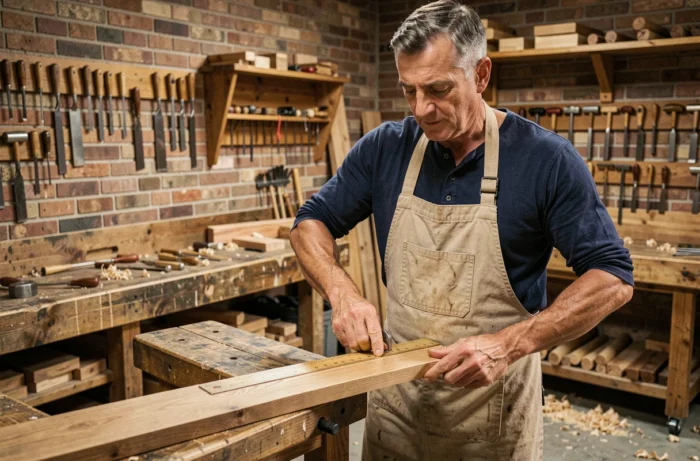
What criteria truly distinguish a local carpenter from an online retailer or a large specialized store? The answer does not rely on a single variable but on a set of measurable parameters: regulatory compliance, mastery of materials, adaptation to existing building constraints, and post-installation follow-up. This article analyzes these gaps to help assess the relevance of a local carpenter in a custom project.
Custom Carpentry and Regulation 2026: What Changes for Quotes
The regulatory framework surrounding energy renovation has tightened in recent months, with direct consequences for carpentry projects. Decree No. 2026-822 of August 25, 2026, and the order of July 7, 2026, impose new obligations on construction professionals.
Another notable change: the BOFiP updated on September 9, 2026 (reference ACTU-2026-00036) eliminates the separate paper certificate for compliance with reduced VAT rates. Certification is now done directly on the quote or invoice. A craftsman who manages his own administrative documents incorporates this change without intermediaries, reducing the risk of error for the client.
For those who wish to learn more about Menuiserie Airaines, this type of regulatory compliance is part of the concrete checks to be carried out before signing a quote.
Wood, PVC, or Aluminum: Material Comparison for Custom Carpentry
The choice of material determines the durability, insulation, and budget of a carpentry project. Here is a synthetic comparison of the three main families.
| Criterion | Wood | PVC | Aluminum |
|---|---|---|---|
| Thermal insulation | Very good (low natural conductivity) | Good (integrated insulation chambers) | Average (thermal break necessary) |
| Maintenance | Regular (stain or paint every few years) | Minimal (regular cleaning) | Minimal |
| Customization of shapes | Very high (curvatures, moldings, atypical profiles) | Limited to standard profiles | High (slim profiles, large spans) |
| Adaptation to old buildings | Excellent | Correct | Good |
| Environmental impact | Low if certified wood | Recyclable but derived from petrochemicals | Recyclable, but energy-intensive extraction |
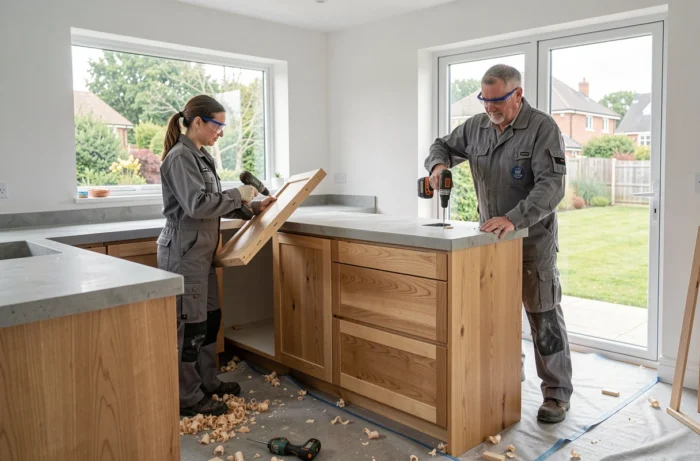
Wood remains the reference material for renovation projects on old buildings or in protected areas. Its ability to reproduce historical molded profiles often makes it necessary when the Architects of the Buildings of France impose aesthetic constraints.
On the other hand, aluminum dominates in new constructions with large openings. Its slim profiles maximize glazed areas, a plus for windows and sliding doors in contemporary design projects.
PVC covers the majority of common renovation sites. Its thermal performance/cost ratio makes it the most widespread solution for replacing standard windows.
Local Carpentry and Project Follow-Up: The Concrete Gaps with Large Retailers
The difference between a local carpenter and a large retail network goes beyond the delivered product. It is measured at several stages of the project.
- On-site measurements allow for identifying squaring defects, expansion gaps, and access constraints before manufacturing. An error of a few millimeters in remote measurements can render a custom carpentry unusable.
- Manufacturing or choosing regional suppliers shortens delivery times and facilitates adjustments during production, especially for gates, shutters, or doors with non-standard dimensions.
- The local after-sales service intervenes without going through a national call center. A hardware adjustment, a seal adjustment, or a lock recalibration is often handled within the week.
A local craftsman stakes his reputation on every project. In a limited geographical area, word-of-mouth works both ways, providing a form of natural quality control.
Energy Renovation Projects: Windows and Work Packages
Changing carpentry must now be part of a work package to remain eligible for energy renovation aids. This evolution, documented by Performance BTP and Menuiserie C2R, changes how a renovation project is structured.
A carpenter who works in a local network with drywall installers, facade specialists, or heating engineers can assemble a coherent package. The insulation of windows combined with interior insulation or a change in the ventilation system allows access to funding.
The updated DPE (Energy Performance Diagnosis) with the new calculation method also influences the choice of carpentry. Aluminum windows with thermal breaks can be sufficient to shift a home from one energy class to another, according to the analysis published by Cunha and Castera. Previous diagnostics can be updated via the ADEME DPE-Audit Observatory without a new on-site visit.
Custom Design for Interiors: Stairs, Storage, and Space Planning
Carpentry is not limited to exterior openings. Custom interior design (stairs, libraries, closets, wall coverings) represents a significant part of local artisans’ activities.
A custom staircase, for example, requires a three-dimensional measurement of the opening, a calculation of tread and riser height in accordance with accessibility standards, and a choice of wood species suitable for the use. These parameters cannot be managed by an online configurator.
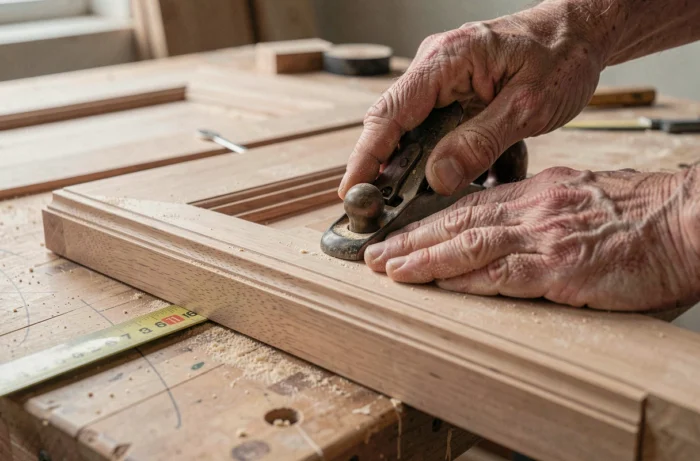
The quality of an interior layout is judged by the millimeter adjustment between the furniture and the walls, floors, or ceilings, which are never perfectly straight. This is precisely where manual craftsmanship and on-site presence make a difference compared to an industrial product to be assembled by oneself.
Replacing windows, installing gates, or creating a custom storage space fall under different logics but share a common point: the precision of the initial measurements determines the success of the project. Choosing a carpenter capable of intervening across all these areas simplifies coordination and reduces interfaces between trades.