
Arranging and decorating your home involves making trade-offs between aesthetics, comfort, and health. Before choosing a wall color or a piece of furniture, one often overlooked factor can change the game: indoor air quality, directly related to the materials used. This article compares the concrete levers of arrangement according to their real impact on daily life, intersecting decoration, space optimization, and health criteria.
Decorative materials and indoor air quality: what decor guides overlook
Most advice for decorating a home focuses on trendy colors or designer furniture. They overlook a measurable factor: volatile organic compounds (VOCs) emitted by paints, varnishes, and particleboard.
In France, paints intended for indoor use carry mandatory labeling from A+ (very low emissions) to C (high emissions). Choosing a paint rated A+ significantly reduces indoor air pollution compared to paints rated A or B, often for a modest additional cost.
For wooden furniture, FSC and PEFC labels guarantee sustainable forest management. Beyond the ecological aspect, these certifications generally come with controls on the adhesives and chemical treatments of the wood, which also limits formaldehyde emissions in the room.
- Wall paints: always check the VOC emission class (A+ recommended) before purchasing, even for “natural” or “eco” shades.
- Panel furniture (MDF, particleboard): prioritize products with an FSC or PEFC label, which imply requirements on chemical treatments.
- Vinyl flooring: costs vary according to sources between ten and fifty euros per square meter, but phthalate-free models should be prioritized for living areas.
Integrating this health filter from the material selection phase means decorating your home without compromising the air quality you breathe every day. Resources like the Habiz website for the home allow exploration of these topics by intersecting decoration and healthy living.
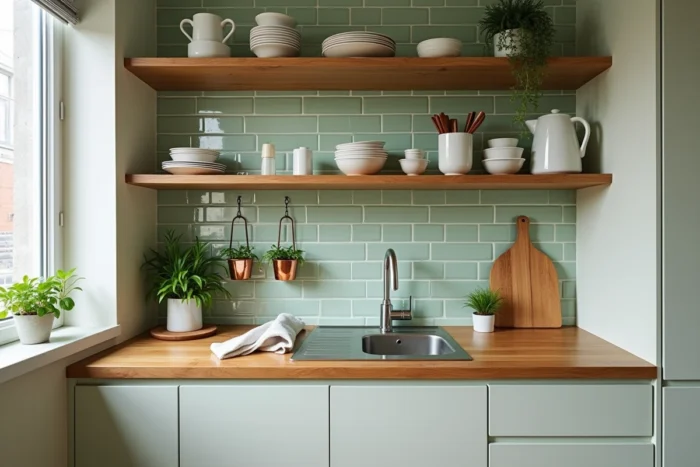
Vertical storage and multifunctional furniture: comparative table of solutions
Optimizing space is the most frequently cited lever in interior design guides. Two approaches dominate: vertical storage (wall shelves, columns, hooks) and multifunctional furniture (sofa bed, extendable table, storage bench). Their relevance depends on the layout of the home.
| Criterion | Vertical Storage | Multifunctional Furniture |
|---|---|---|
| Floor space gain | High (frees up the entire floor under the shelves) | Moderate (the furniture occupies floor space but replaces two items) |
| Tenant adaptability | Medium (wall fixings, risk of holes) | High (no modifications to the home) |
| Entry cost | Low (simple shelves are accessible) | Variable (a sofa bed costs more than a standard sofa) |
| Visual impact | Strong (draws the eye upward, visually enlarges) | Neutral (blends into the decor) |
| Maintenance | Dust on open shelves | Mechanisms to check (hinges, rails) |
For a small home, the combination of both approaches yields the best results. A wall utilized from floor to ceiling with shelves, combined with a coffee table with storage, frees up enough space so that the room does not appear cluttered.
In contrast, in a house with large rooms, vertical storage serves more of a decorative purpose (wall library, displayed collection) than a functional need. Multifunctional furniture also loses its appeal there, as space is not lacking.
Colors and light: the concrete differences between common choices
Decor guides often recommend “choosing colors that reflect you.” This advice, while valid, lacks operational precision. Two variables deserve to be crossed: the shade of the walls and the number of light sources.
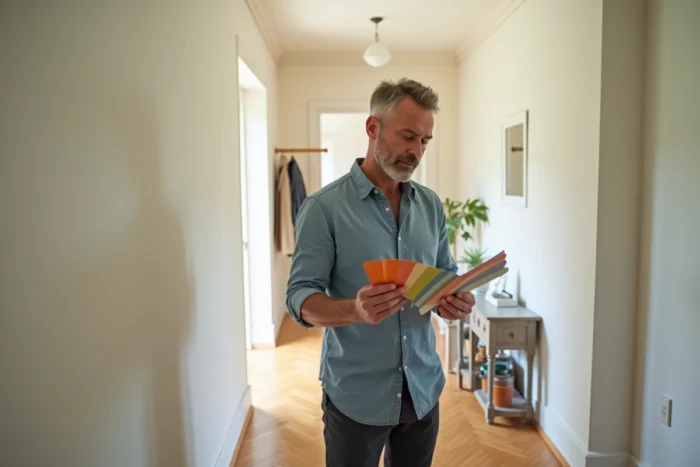
Similar shades on walls, ceilings, and woodwork visually soften the boundaries of a room. This technique works particularly well in narrow spaces (hallways, entries, bathrooms). Conversely, an accent wall in a bold color creates depth in a square or overly uniform room.
Artificial light plays a complementary role. Multiplying light sources (table lamp, wall sconce, pendant, string lights) rather than centralizing everything on a single ceiling fixture allows for modulation of the ambiance according to the room’s use and the time of day.
Entry and passage rooms: a specific use case
The entry is the first room seen and often the most neglected. A functional layout relies on three elements: a shoe storage solution, a coat hook or rack, and sufficient lighting. Nothing more.
Adding a mirror in the entry visually doubles the space and enhances natural light if a source exists nearby. Wall stickers or repositionable wallpaper offer personalization without renovation, suitable for tenants who cannot paint.
Decoration without renovation: options to prioritize in rentals
Renters represent a significant portion of those looking to decorate their interiors. The constraints are real: no permanent painting, no heavy fixings, obligation to return the property in its original state.
- Repositionable wallpaper: applies and removes without damaging the surface, available in a wide range of patterns. Ideal for a temporary accent wall.
- Large frames placed on the floor or on a shelf: no holes in the wall, marked decorative effect, easily movable.
- Rugs: the quickest solution to transform a floor without intervention, with an immediate impact on acoustic and thermal comfort.
- Vinyl flooring laid over existing flooring: a more committed alternative, but reversible if the original floor is protected underneath.
These solutions share a common point: they are reusable from one home to another. The investment pays off over several moves, which is not the case with traditional renovations.
The choice between light decoration and structural arrangement ultimately depends on one parameter: the expected duration of occupancy of the property. For a stay of less than two years, solutions without renovation are sufficient. Beyond that, more durable interventions (painting, fixed shelves, flooring) begin to justify themselves by the comfort gained in daily life.