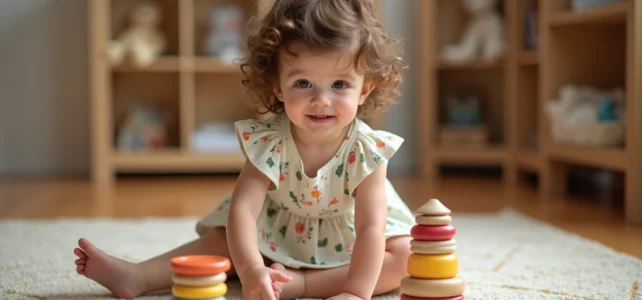
An eighteen-month-old child banging on a pot with a wooden spoon while dinner heats up: this is an effective play activity, requiring no preparation or dedicated materials. Toddlers do not need structured sessions to experience joy. What matters is the regularity of micro-interactions, the quality of the adult’s presence, and the choice of activities suited to their developmental stage.
Play activities integrated into daily routines
The playful potential of repeated daily gestures is often underestimated. Bath time, diaper changes, meals, or bedtime are moments when the child is available, relaxed, and where a little game creates immediate connection.
During diaper changes, we can name each body part while touching it. At mealtime, tapping a rhythm on the table with the palm before offering the spoon captures attention and provokes laughter. At bath time, transferring water between two cups works on hand-eye coordination without the child being aware of “doing an activity.”
Repeated micro-games within routines capture attention better than isolated activities. This regularity reassures the toddler, as they anticipate the game and prepare for it. There’s no need to renew the toy stock: repetition, far from boring them, enhances their pleasure.
To vary the fun at home, we can also explore the Béabonheur game on Bébé Bonheur, which offers recreational activities designed for toddlers.
Sensorial activities without toys for babies at home
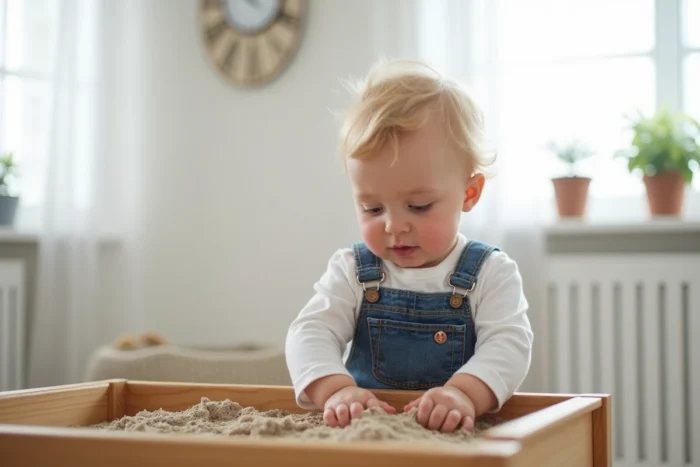
Before investing in materials, we have everything at hand. The simplest sensory activities are often the most engaging for a child between six months and three years.
- The treasure box: gather five or six everyday objects with different textures (sponge, wooden spoon, satin fabric, cork stopper) in a basket. The child grabs them, brings them to their mouth, compares them. Each texture stimulates a distinct sensory circuit.
- Free finger painting: spread a sheet on the floor, offer two colors of washable paint. We do not guide the gesture; we let the child experiment with the trace, the consistency, the mixing.
- Filling and emptying: containers of different sizes with rice, pasta, or water. This seemingly repetitive game works on fine motor skills, the concept of capacity, and patience.
The idea is not to multiply proposals in the same day. A child who focuses for twenty minutes on a single activity gains more than a child who flits between six sensory bins.
Musical awakening and vocal games from birth
Hearing is the most mature sense at birth. Babies recognize their parents’ voices even before distinguishing their faces. Starting from this fact changes how we approach musical awakening.
Singing a gesture song during bath time is as valuable as a formal music awakening session. Short songs with associated movements (clapping hands, touching the nose, raising arms) combine auditory stimulation, language, and gross motor skills. There’s no need to sing perfectly: it’s the prosody, rhythm, and gaze that matter.
For children from one year old, offering small wooden instruments (maracas, tambourine, claves) allows for a transition from vocal play to sound exploration play. We tap, shake, and scratch. The child discovers they can produce a sound, modulate it, and stop it. This control over the sound environment is a direct source of joy.
Feedback varies on this point, but several French-speaking speech therapists highlight “no-material” activities for 0-3 year-olds: speaking slowly while exaggerating intonation (parentese), naming everyday objects when the child looks at them, or practicing intentional waiting (leaving a silence after a question for the child to attempt to respond). The joy of the baby is linked to the quality of vocal exchange, not to the variety of toys.
Wooden toys and play activities: concrete selection criteria
When deciding to buy materials, the market for play toys is dense. A few operational criteria can help sort through without getting lost.
A good play toy serves only one function at a time. Multifunctional toys (light, sound, movement, textures, buttons) scatter attention. A stacking cube, a wooden teething ring, a ball with holes: these simple objects allow the child to invent their use.
- Prefer raw wood or natural materials: they offer a sensory feedback (weight, temperature, grain) that plastic does not replicate.
- Check the size of the pieces: for children under three, no piece should fit through a toilet paper roll (a simple choking hazard test).
- Observe before buying: if the child ignores a toy after two spaced presentations, it’s not the right time. Storing and reintroducing it a few weeks later often works better than forcing interest.
Stacking or nesting wooden toys remain among the most versatile between one and three years old. They support fine motor skills, shape and color recognition, and also lend themselves to symbolic play (the tower becomes a castle, the cylinder becomes a cake).
Family games to create moments of shared joy
The joy of a toddler is rarely solitary. It almost always arises in interaction. A few concrete situations work reliably.
Cooking together, even at two years old, allowing the child to touch the dough, pour flour into the bowl, or mash a banana with a fork. The result matters little. What counts is the pleasure of doing with the adult, not the outcome of the activity.
Outdoor walks with a simple mission (collecting three different leaves, finding a smooth stone) transform an ordinary stroll into an exploration game. The child observes, compares, chooses. These activities in nature develop curiosity without any materials.
The adapted game of hide-and-seek (hiding behind a curtain, reappearing while saying “peekaboo”) remains a classic for a precise reason: it works on object permanence, a major cognitive milestone. And it triggers genuine laughter every time.
What connects all these proposals is the absence of expected performance. A toddler does not play to succeed. They play to feel, and joy comes from the freedom to explore without imposed objectives.