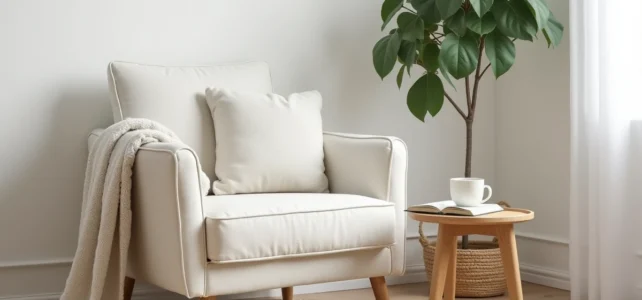
A sofa that is too deep, forcing you to stuff cushions behind your back, a wall repainted in off-white that turns yellow under the LED lighting of the kitchen: we have all experienced that gap between decorative intention and daily reality. The 2026 decor trends offer concrete solutions to correct these irritants, provided they are adapted to the reality of each room rather than simply replicating a mood board found online.
Curved furniture: what it changes in a narrow living room
When you push an angular sofa against the wall of a living room of less than 20 m², the passage to the kitchen is reduced to a single-file line. Furniture with rounded lines, which is very present in the 2026 collections, is not just an aesthetic choice. They free up circulation angles.
The Italian manufacturer Poliform indicates that more than half of its sales now concern curved models. This proportion is found in other European brands as well. The rounded sofa, the oval coffee table, or the enveloping armchair allow you to navigate around the furniture without changing its position.
For a rectangular living room, you can explore the decor universe on Place A to find pieces that fit this type of configuration. The idea is not to furnish more, but to furnish differently: a single curved sofa sometimes replaces a straight sofa plus an accent chair.
In practical terms, before ordering, measure the passage between the furniture and the opposite wall. Less than 70 cm is uncomfortable. A curved piece of furniture gains 10 to 15 cm of passage compared to a right angle, simply because the curve pulls back the most protruding point.
2026 Color Palette: Emotional Stability Rather Than “Wow” Effect
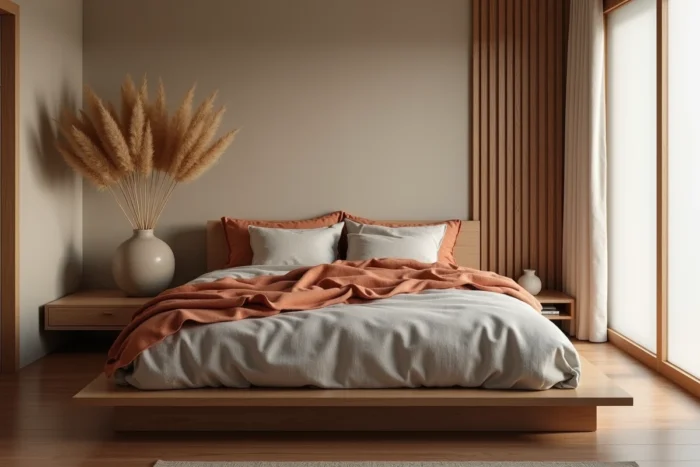
The dominant tones this year (eucalyptus green, sandy beige, misty blue, desaturated terracotta, cocoa) do not aim to impress. According to Venidom, these palettes respond to a need for emotional stability identified by interior design professionals.
In practice, what does this mean for a living room or kitchen wall? Avoid harsh contrasts between walls and furniture. A sage green wall works with light wood and ecru linen. A terracotta wall pairs with matte black kitchen accessories without creating visual tension.
The Trap of Artificial Lighting on Neutral Tones
Neutral colors change radically depending on the bulb’s temperature. A sandy beige under 4,000 K lighting (cool white) appears dirty gray. Under 2,700 K (warm white), it regains its warmth.
- For a living room or bedroom, stick to bulbs between 2,700 and 3,000 K, which respect the warm tones of the 2026 palettes.
- In the kitchen, a 4,000 K task light remains useful for visual comfort, but it should be complemented by a warmer ceiling light for the overall ambiance.
- Feedback varies on LED strips in cornices: some find it flattens wall colors, while others appreciate the indirect effect. It’s best to test a paint sample under real lighting before painting the entire room.
Biophilic Decoration in Apartments: Beyond Potted Plants
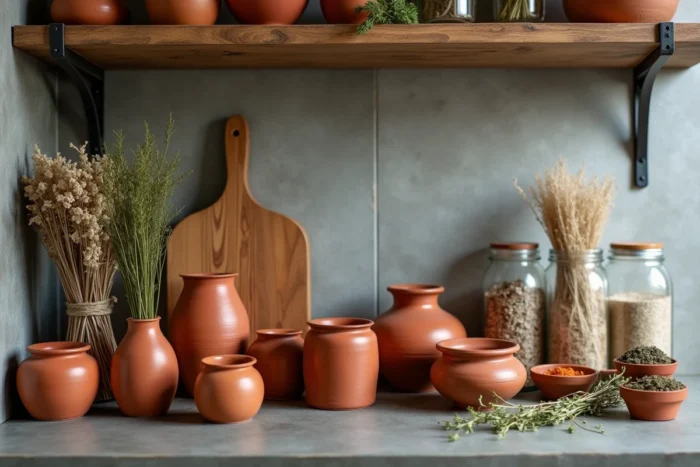
The biophilic trend is not limited to lining up monstera pots on a shelf. According to Secur-Home, biophilic decor is the fastest-growing trend since 2024 in urban apartments. It incorporates natural materials (raw wood, stone, plant fibers), maximizes natural light, and introduces greenery in a structural way.
A stabilized green wall (moss or dried lichen) requires no watering or direct light. It works in a windowless entryway or a dark hallway, where a green plant would not survive two weeks.
Natural Materials in the Kitchen and Living Room
Light wood, rattan, washed linen, and artisanal ceramics remain at the forefront of the 2026 trends. They can be found on countertops, light fixtures, and upholstery textiles.
The point to watch: untreated raw wood stains when in contact with water. In the kitchen, opt for oiled wood or a matte varnish that maintains the natural look without the drawbacks. On a living room piece, a simple hard oil treatment is sufficient and should be renewed once a year.
Slow Decor: Buy Less to Decorate Better
The “slow decor” trend encourages limiting the number of pieces in each space. In practice, remove before adding. A living room with a well-chosen sofa, coffee table, and lamp creates a clearer effect than ten decorative objects piled on three shelves.
This approach aligns with the vintage style, which is very present in 2026. A piece of furniture found in a thrift store or inherited from family brings a patina that new furniture cannot replicate. A single well-placed vintage piece anchors the entire ambiance of a room.
- Start by clearing a surface (dresser, buffet, shelf) and only put back objects that serve a function or provide true visual pleasure.
- Limit decorative accessories to three per visual zone (a shelf, a side table, a niche).
- Favor materials that age well: leather, solid wood, stoneware, patinated brass.
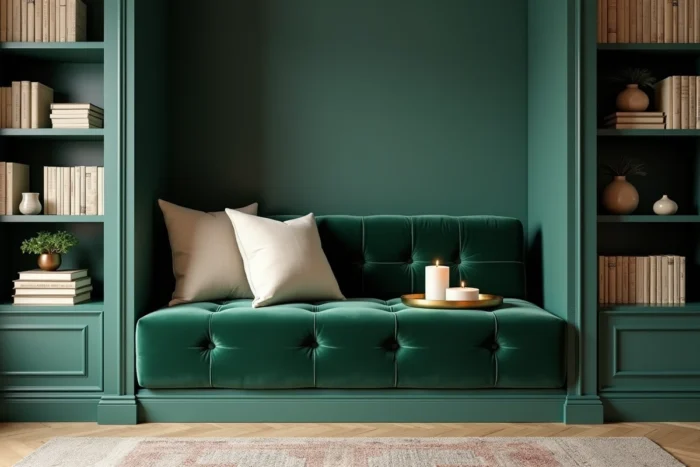
Timeless decoration rarely relies on impulse purchases. A calming interior is built through subtraction as much as addition, testing each change under the real conditions of the room (light, circulation, daily use). The 2026 trends all move in this direction: less volume, more coherence between materials, colors, and the way we actually live at home.