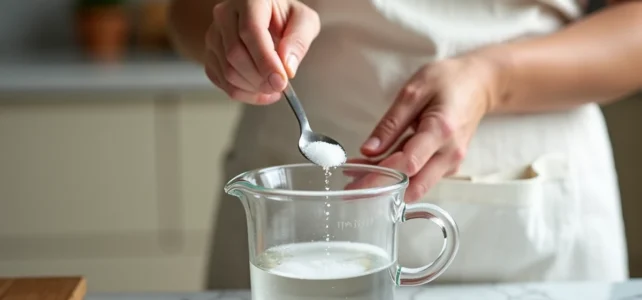
When you add salt to a liter of water, the useful amount depends entirely on what you’re preparing. Cooking water, saline solution, preservation brine, and a swimming pool do not require the same dosage at all. Mixing without a guideline wastes salt or fails to achieve the desired effect. Understanding which weight corresponds to which use avoids approximations and repeated corrections.
Salt and saturation: the physical limit imposed by water
Before discussing dosage, we must establish a framework often overlooked by pool-oriented guides. Water cannot dissolve an infinite amount of salt. At room temperature, the solubility of sodium chloride in water reaches a ceiling beyond which the crystals remain at the bottom without dissolving.
This saturation threshold is around 360 g per liter at 20 °C. In other words, beyond this concentration, no matter how much you stir, the salt will no longer disappear. This basic chemistry fact changes the perspective: all common dosages (cooking, medicine, pool) are far from saturation, between 1% and 10% of the maximum capacity of water.
Knowing that we are operating on such a wide scale allows us to put the differences between uses into perspective. The question is not to find a magic number, but to choose how much salt for 1 liter of water according to the expected result.
Salt dosage per liter according to specific use
Here we group the main scenarios encountered daily and in technical environments. Each concentration responds to a different logic.
Cooking and cooking water
For cooking pasta or vegetables, most recommendations hover around 10 g of salt per liter of water. This is a common guideline in cooking schools. Below this, the water does not season the food enough during cooking. Above this, the dish becomes too salty if not rinsed.
For preservation brine (pickles, olives, sauerkraut), we go much higher, often between 30 and 80 g per liter depending on the recipe and the intended preservation duration. The goal is no longer taste but inhibition of bacterial growth through osmotic pressure.
Saline solution: the medical reference
The concentration of saline solution (NaCl 0.9%) corresponds to about 9 g of sodium chloride per liter of water. This dosage replicates the tonicity of human blood plasma, according to the European Pharmacopoeia monograph. It is used for nasal washes, intravenous infusions, and wound rinsing.
9 g per liter is the isotonic reference dosage in hospital settings. Any more concentrated solution is called hypertonic, and any more diluted solution is hypotonic. Both have precise medical applications, but 0.9% remains the standard.
Saltwater pool and electrolysis
For a pool treated by electrolyzer, the recommended concentration generally ranges from 3 to 5 g of salt per liter of water. Some devices require up to 7 g/L depending on their design. The electrolyzer’s manual specifies the exact target value.
This dosage is significantly lower than that of seawater (about 35 g/L). This is why the water in a saltwater pool does not sting the eyes and has a very mild taste. The salt serves as a raw material for the electrolysis cell, which transforms it into active chlorine to disinfect the pool.
Comparative table of salt concentrations per liter
| Use | Approximate concentration | Objective |
|---|---|---|
| Cooking water (pasta) | About 10 g/L | Season the food during cooking |
| Saline solution | 9 g/L (NaCl 0.9%) | Replicate the tonicity of blood plasma |
| Saltwater pool | 3 to 7 g/L depending on the electrolyzer | Produce chlorine through electrolysis |
| Preservation brine | 30 to 80 g/L depending on the recipe | Block bacterial growth |
| Seawater | About 35 g/L | Natural concentration |
| Saturation (20 °C) | About 360 g/L | Physical limit of dissolution |

Common salt dosage errors in water
Some pitfalls regularly arise, regardless of the context of use.
- Confusing g/L and kg/m³ in pool settings. The two units are equivalent (1 g/L = 1 kg/m³), but some users mistakenly multiply, thinking they are converting, which doubles the actual dosage.
- Using iodized or fluoridated salt in a pool. The additives present in table salt can clog the electrolysis cell and reduce its effectiveness. The recommended salt for a pool is a high-purity pool salt, without anti-caking agents.
- Not considering the water temperature. The solubility of salt slightly increases with heat. In practice, the difference remains marginal for common dosages, but in concentrated brine, cold water may refuse to dissolve the last grams.
- Pouring salt directly onto the liner or the pool’s surface instead of distributing it in circulating water. Concentrated crystals in one spot can cause stains or local damage.
Measuring the salt concentration already present in the water
In a pool, correcting a dosage without first measuring the current level is like adjusting seasoning without tasting. A salinity tester (portable conductivity meter or specific strips) provides the concentration in g/L or ppm. The measurement takes a few seconds.
For a pool, the amount of salt to add depends on the water volume and the already dissolved level. The formula remains simple: multiply the volume in cubic meters by the difference between the current level and the target level (in kg/m³). A 50 m³ pool that is missing 2 g/L requires 100 kg of salt.
In cooking or brine, feedback varies on this point, but a letter scale or kitchen scale is sufficient to measure to the nearest gram. No need for sophisticated instruments: the accuracy of a standard scale comfortably covers the tolerance margin of these preparations.
The salt dosage per liter of water is not universal. Each use sets its own concentration, from 3 g/L for a pool to over 30 g/L for preservation brine. The most useful reference remains the saline solution at 9 g/L, which serves as a comparison point in almost all areas where salty water is handled.