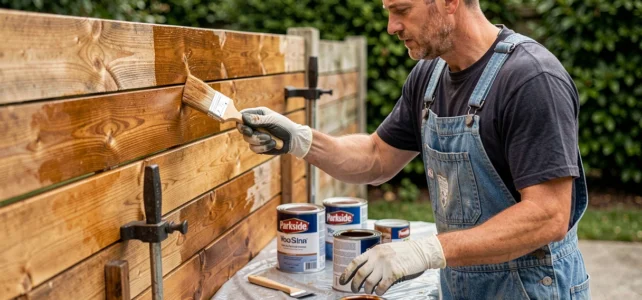
Between the Parkside polyurethane stain sold at Lidl and the wood protection gels offered by specialized brands, DIY enthusiasts face a choice that goes beyond just price. The chemical composition, indoor air emission ratings, and outdoor durability vary significantly from one product to another. This article compares these parameters to guide a purchase suitable for each use.
Emission Ratings and VOC Regulations for Wood Stains
Since January 1, 2023, decree no. 2022-1689 has modified the regulatory value of formaldehyde in indoor air in France. The new reference sets 100 µg/m³ for short-term exposure. This threshold directly concerns finishing products applied to wood indoors, including stains.
The A+, A, B, C labeling system remains the most reliable benchmark for comparing products. An A+ rating guarantees less than 10 µg/m³ of formaldehyde and less than 1,000 µg/m³ of total VOCs under standardized testing conditions. Indoor air quality specialists recommend aiming for this label rather than relying solely on the “water-based” or “low VOC” mention on the packaging.
Before purchasing a stain or protection gel, checking the emission class on the product’s technical data sheet helps eliminate formulations with high volatile compound content. This criterion is particularly relevant for poorly ventilated rooms or indoor furniture.
| Criterion | Class A+ | Class A | Class B |
|---|---|---|---|
| Formaldehyde (µg/m³) | Less than 10 | Less than 60 | Less than 120 |
| Total VOCs (µg/m³) | Less than 1,000 | Less than 1,500 | Less than 2,000 |
| Indoor Relevance | Suitable | Acceptable | Not recommended for closed rooms/areas |
This table helps quickly locate a product. A Parkside stain and wood protection gel with an A+ rating offers a higher level of health safety, regardless of the type of resin used.
Parkside Lidl Stain: Real Positioning According to User Feedback
Syntheses of reviews published in 2025 and 2026 on Parkside tools and products converge on one observation: the brand is suitable for occasional or regular domestic use of a leisure type. Users employing it on intensive or professional projects report limitations, particularly regarding the longevity of the treatment on wood highly exposed to the elements.
The average rating given to Parkside products hovers around four stars out of five. This score reflects a quality-price ratio deemed acceptable for home DIY but not a performance comparable to professional stains.
What Users Appreciate
- The purchase price significantly lower than specialized brands, making it suitable for treating a small garden area or outdoor furniture
- Availability in Lidl stores during DIY promotional events, without the need to order online
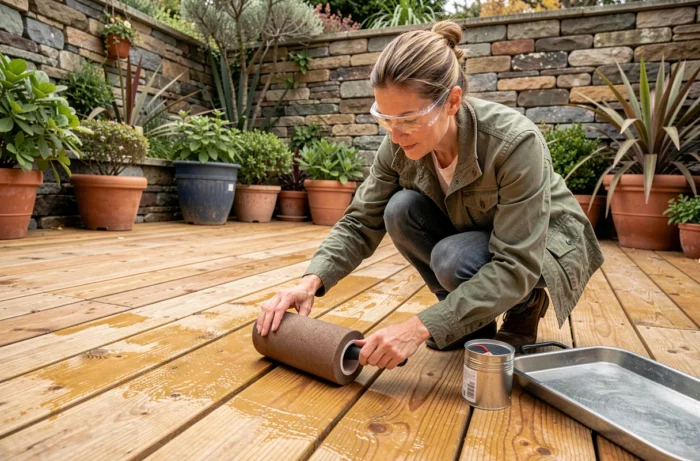
- Easy application with a flat brush, accessible to beginners without special equipment
What Users Criticize
- A shorter lifespan than polyurethane stains from brands like V33 or Bondex, especially on wood exposed to sun and water
- An uneven finish on softwoods if surface preparation is insufficient
- The frequent absence of a detailed technical data sheet in stores, complicating the verification of emission ratings
In summary, the Parkside stain fulfills its role for a domestic setting without a demand for maximum durability. For a heavily used terrace or a garden shed in full sun, feedback suggests comparing with more concentrated polyurethane resin formulations.
Wood Protection Gel or Stain: Choice Criteria According to the Support
The stain penetrates the wood fibers without forming a surface film. The thicker protection gel is applied in a layer and offers a physical barrier against moisture. This is not a question of quality but of intended use.
On untreated new wood (pine, fir, spruce), the stain is the first choice. It colors while allowing the material to breathe. A gel will be more suitable for already aged or gray wood, where natural penetration is reduced due to fiber wear.
Surface Preparation: The Step That Changes the Result
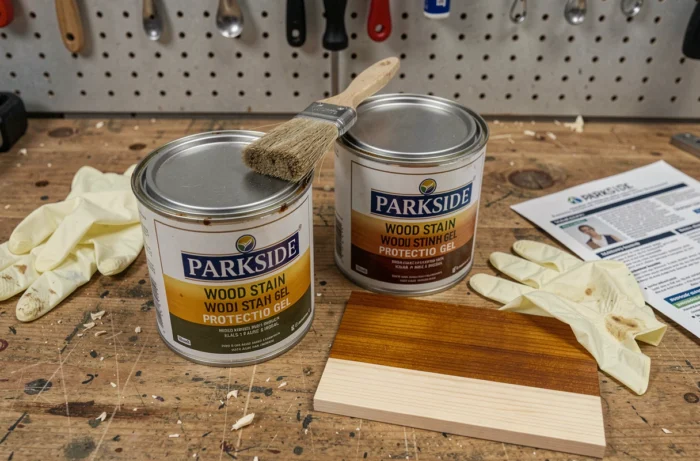
Medium to fine sanding is necessary before any application. On exterior wood that has already been stained and is powdery, light machine stripping (orbital sander or vibrating saw with sanding pad) removes residues without digging into the grain.
Applying a stain or gel on poorly prepared wood divides the duration of protection in half. DIY forums are full of testimonials from disappointed users who skipped this step.
Dust removal after sanding is equally crucial. A damp cloth or a shop vacuum is sufficient. Application is then done in thin layers, following the grain, with complete drying time between each coat.
Budget and Renewal Frequency: The Real Cost of a Stain
The initial purchase price does not tell the whole story. A cheap stain that requires two applications per year costs more over three years than a premium stain renewed every two to three years.
The real cost is calculated by multiplying the price per liter by the number of annual coats, taking into account the surface to be treated. For a standard garden shed, the difference can represent several dozen euros over the lifespan of the treatment.
Parkside products fall into the lower range of the initial budget. However, user feedback indicates a higher renewal frequency outdoors compared to specialized brand stains. This parameter deserves to be included in the calculation before making a decision.
The final choice thus depends on the support (new or old wood), exposure (indoor, shaded outdoor, full sun), and the budget considered over several seasons. The A+ emission class remains the non-negotiable criterion for any indoor use, regardless of the chosen brand.