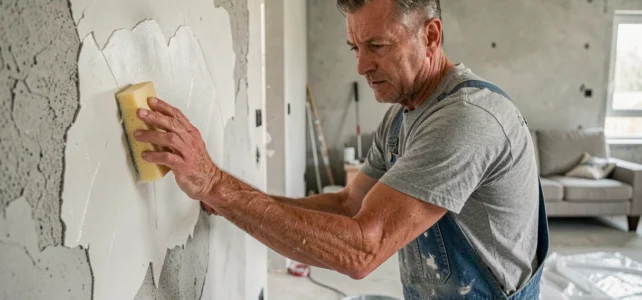
Removing dry plaster from a wall is not just about choosing between scraping and wetting. The result depends on the type of plaster (gypsum, cement, lime), the thickness of the remaining layer, and the substrate underneath. Comparing the available methods allows you to target the one that minimizes damage to the wall while reducing working time.
Attack angle and pressure on the spatula: the often-overlooked factor
Most guides recommend a spatula or a painter’s knife for removing dry plaster. Few specify that the attack angle radically changes the outcome. Working flat, pushing the blade parallel to the wall, tears the surface of the substrate (gypsum, drywall, stone) along with the plaster.
Several recent experiences from interior renovation sites converge on this point: a low angle, between 15 and 30 degrees, protects the substrate. The blade slides under the plaster layer instead of biting into the wall. On a fragile substrate like a drywall partition, this difference prevents digging grooves that will then need to be filled.
For thick layers, a wide chisel oriented at a low angle, struck with a hammer, detaches entire plates without damaging the substrate. On a stone or brick surface, this technique reduces the risk of chipping masonry pieces along with the plaster.
When it comes to easily dissolving dry plaster, the initial mechanical action remains the first step before any chemical or wet intervention.
Methods for removing dry plaster from walls: comparison by type of substrate
The choice of method depends as much on the substrate as on the plaster itself. This table summarizes the approaches suited to each common situation in interior renovation.
| Substrate | Type of plaster | Recommended method | Main risk |
|---|---|---|---|
| Drywall (BA13) | Filling plaster | Localized wetting + low-angle spatula | Tearing the drywall paper |
| Stone / brick | Cement plaster | Chisel + hammer, then brushing | Chipping masonry pieces |
| Plastered wall | Decorative plaster (acrylic, lime) | Steam stripper + scraper | Excessive softening of the underlying plaster |
| Concrete | Thick cement plaster | Perforator with flat scraper | Vibrations transmitted to adjacent partitions |
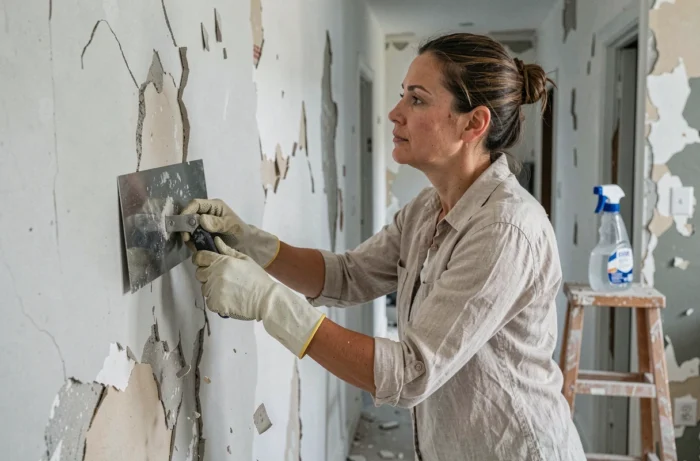
On drywall, the wetting must remain very localized and brief. Allowing water to penetrate for too long soaks the paper and weakens the board. Working in small areas, wetting a surface of about half a square meter at a time, then scraping immediately, yields the best results.
On stone or brick, cement plaster adheres much more strongly than gypsum plaster. The chisel remains the most suitable tool. However, on a stone wall in an old house, removing poorly applied cement plaster may expose weakened joints that will require complete repointing.
Hybrid approach: combining mechanical and softening methods for stubborn residues
A point rarely developed in existing content concerns the combination of two methods on the same wall. Mechanical detachment removes most of the layer, while softening addresses the residues.
In practice, this hybrid approach unfolds in two stages:
- First, use a chisel or rigid spatula to remove plates and excess thickness. This phase represents the majority of the work and generates the most dust.
- Then apply hot water (with a sprayer or sponge) to the fine residues that remain stuck. A waiting time of a few minutes is sufficient for a gypsum-based plaster.
- Scrape the softened residues with a flexible spatula, always maintaining a low angle to avoid scratching the substrate.
- On an acrylic-based decorative plaster, replace the water with a steam stripper, which softens the binder without over-soaking the wall deeply.
This sequence avoids a common pitfall: applying water or steam to a thick layer, making it mushy and more difficult to remove than when dry. Water is only effective on fine residues, not on layers several millimeters thick.
Preparing the site before removing dry plaster
Removing plaster generates a significant amount of dust and debris that many underestimate. Recent content from renovation sites emphasizes peripheral protection as a preliminary step, not as an optional detail.
Before touching the wall, three precautions change the course of the work:
- Seal electrical outlets and switches with tape. Plaster or cement dust infiltrates the boxes and can cause false contacts.
- Cover the floor with a thick tarp (not just plastic sheeting), extending up along the baseboards. The pieces of plaster that fall are heavy and can puncture thin protections.
- Mask openings (doors, passages) with tarps secured with masking tape to confine dust within the workroom.
Cement dust is alkaline and irritating to the respiratory tract. Wearing an FFP2 mask while scraping is not an excessive precaution, especially in a poorly ventilated room.
Plaster on stone walls: a particular case that deserves prior diagnosis
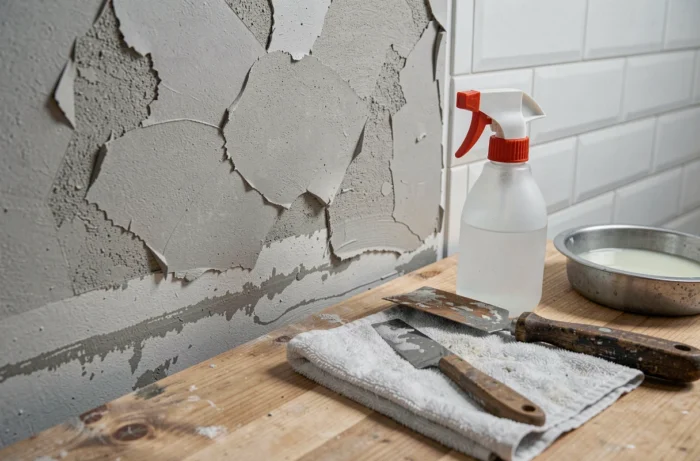
Removing cement plaster from an old stone wall raises a question that other substrates do not pose: should everything really be removed? Cement plaster applied to stone prevents the wall from breathing and traps moisture inside the masonry. Removing it is often relevant, but doing so without caution can destabilize poorly bonded stones.
On this type of wall, testing the plaster with a hammer before scraping allows you to identify areas where it is peeling off on its own (hollow sound) and those where it still adheres strongly. Hollow areas come off easily with a chisel. Adhering areas may sometimes require a grinder with a diamond disc, or professional sandblasting if the surface is significant.
Once the plaster is removed, the exposed stone wall requires careful brushing and often repointing with lime before any new finish. Applying a new plaster directly onto degraded joints compromises its durability in the medium term.
The choice of method, whether mechanical, wet, or hybrid, primarily depends on the initial diagnosis: type of plaster, nature of the substrate, residual thickness. A drywall wall with traces of filling plaster and a stone wall covered with cement do not fall under the same project, nor do they require the same tools.