
Anatomical structures whose names begin with the letter K pose a particular problem for French-speaking students: most come from Greek, Latin, or Germanic roots, and their spelling does not follow the usual conventions of the French language. This linguistic gap complicates memorization and blurs references during the first months of training.
Standardized terminology in anatomy: why the letter K is confusing
The international anatomical nomenclature, codified by the Terminologia Anatomica, favors Latin. In this context, the letter K rarely appears in the initial position. The terms that contain it in French are often direct borrowings from Ancient Greek or German, retained as such in clinical usage.
The keratinocyte, the predominant cell of the epidermis, derives its name from the Greek keras (horn). The cyst, a closed sac filled with liquid or semi-solid material, comes from kustis (bladder). These Greek roots permeate dermatology, nephrology, and neurology without ever undergoing complete French adaptation.
For a beginner student, the difficulty is not in remembering an isolated word. It lies in the fact that terms beginning with K refer to very different anatomical systems: skin, kidney, knee joint, nervous system. No topographical logic connects them. Therefore, studying the anatomy of the body starting with k requires mapping these terms by system rather than alphabetically.
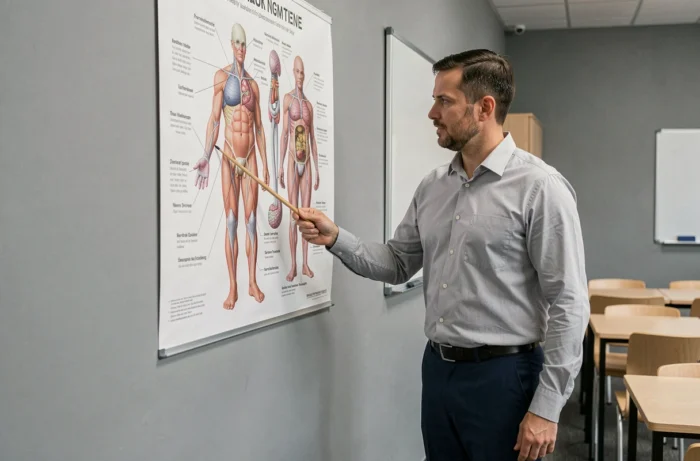
Knee, kidney, skin: structures in K classified by system
Grouping body parts starting with K by anatomical system allows for the creation of functional associations, which are much more solid in memory than a simple list.
Musculoskeletal system and knee joint
The knee contains several terms starting with K. The patella is sometimes referred to as the English term kneecap in bilingual manuals, which creates additional confusion. In French anatomy, the popliteal cyst (or Baker’s cyst), a fluid-filled formation located at the back of the knee, is particularly noted, common in rheumatology.
Kyphosis, the physiological curvature of the thoracic spine, is also part of the axial skeleton. Excessive kyphosis (hyperkyphosis) alters spinal statics and can lead to chronic pain. The student must distinguish normal curvature from pathological deformation from the first-year courses.
Integumentary system: keratinocytes and keratin
Keratin is the structural protein of hair, nails, and the stratum corneum of the epidermis. Keratinocytes, which produce it, represent the vast majority of epidermal cells. Understanding their maturation cycle (from the basal layer to desquamation) is a necessary step in histology.
Urinary system: the kidney and its cysts
The kidney (from the Greek nephros, but the renal cystic pathology retains the K) is the site of hereditary polycystoses. The autosomal dominant polycystic kidney disease remains one of the most studied genetic kidney diseases in nephrology. Simple renal cysts, on the other hand, are common and generally benign.
Memorization method by Greek roots for anatomy
Rather than learning each term in isolation, an approach based on etymological roots reduces cognitive load. Here are the most productive Greek roots for terms starting with K:
- Keras / kerato- (horn): keratinocyte, keratin, keratosis, keratoplasty. All refer to horn-like structures or interventions on the cornea.
- Kustis / kysto- (bladder, pouch): cyst, cystectomy, cystography. The shift from K to C in French complicates searches in indexes.
- Kuphos / kypho- (curved): kyphosis, kyphoplasty. Always related to the spinal column.
- Kinesis / kinési- (movement): physiotherapy, kinesiology. These terms connect anatomy and functional rehabilitation.
Associating each root with a body system transforms a dry list into a semantic network. A student who masters kerato- can deduce the meaning of keratoconus (corneal deformation) without having memorized it.
Reform of health studies and impact on anatomy learning
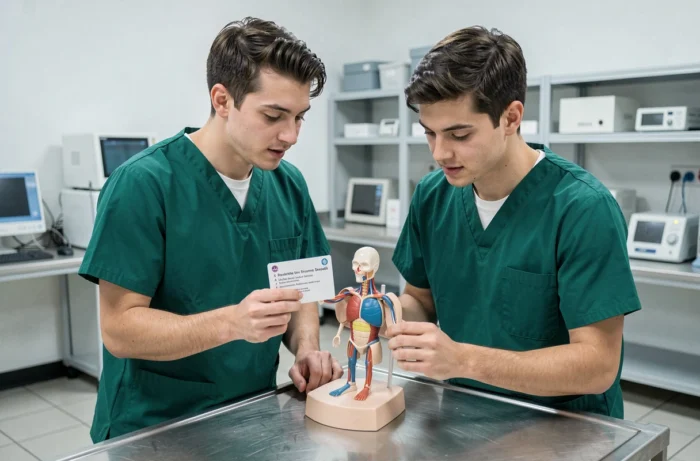
The framework for access to medical studies in France is evolving. The announcement of a unique first year intended to replace PASS and LAS in the fall of 2027 changes the game for students preparing their curriculum. The new health block is described as lighter and more focused on fundamental basics.
This shift towards a focus on transversal skills means that anatomy remains integrated into the fundamental sciences, but the selection of priority content becomes a pedagogical challenge. For a student, knowing which structures in K are actually required (kyphosis, keratinocyte, renal cyst) and which pertain to later specialization (keratoplasty, advanced kinesiology) allows for more effective allocation of revision time.
The available data do not yet allow for conclusions about the detailed program of this future unique year. However, the trend observed in several European faculties confirms that the morphology and structure of the human body maintain a central place in the early semesters.
Common pitfalls with anatomical terms starting with K
The main pitfall concerns the K/C alternation in French. Cyst is spelled with a K, but cystitis with a C, while the Greek root is the same. This orthographic inconsistency leads to errors in bibliographic research and exam papers.
Another trap: confusing kyphosis and lordosis. Kyphosis refers to the posterior convexity (thorax), while lordosis refers to the posterior concavity (cervical and lumbar). Both terms systematically appear together in multiple-choice questions, and the inversion is one of the most frequent errors in axial skeleton anatomy.
One last point deserves attention: the prefix kinési- is sometimes incorrectly linked to descriptive anatomy. It is more related to functional anatomy and biomechanics. During revisions, classifying it in a distinct category avoids overloading the notes dedicated to morphological structures.
Mastering anatomical terms starting with K relies less on brute repetition than on understanding their roots and systemic logic. A student who knows where the word comes from also knows where to place it in the body.